Materias

jueves, 18 de octubre de 2012

Entrada # 4


Laboratorio de Automatización y Control de Sistemas Dinámicos


Para esta semana consistió en elegir un problema y resolverlo.

Primeramente el Problema Elegido:

Determine el rango de valores de K para la estabilidad de un sistema de control con realimentación unitaria cuya función de transferencia en lazo abierto es


En base al libro de Ogata nos dice que para los problemas de estabilidad hay que multiplicar el denominador y nominador con tal de que no exista multiplicación alguna en ellos, quedaría:


Pero como tenemos un valor en el numerador tenemos que pasarlo al denominador, nos quedaría:


Tenemos que:


Y


En base a las ecuaciones anteriores nos quedaría lo siguiente:


En base a la imagen anterior nos quedaría que:


Para determinar el rango de K habrá que tomar los términos de s que contengan a K e igualarlos a 0 cada uno, y esos dos valores serian el rango de K.


------------------------------------------------------------------------------------------------------------------

------------------------------------------------------------------------------------------------------------------

------------------------------------------------------------------------------------------------------------------
Por lo tanto el rango de K debería de ser:


y


 O dicho de otra manera:


Referencias:

Modern Control Engineering Fourth Edition
Katsuhiko Ogata

Entrada # 7

Reporte # 2

Blocks Ciphers

First shall begin with a little explanation about what this is.

Consists of a symmetric key cipher (in which the same key is used to encrypt and decrypt messages) that operates on groups of bits of fixed length, called blocks, applying a transformation invariant.

When performing encryption, this takes a block of plain text as input and produces a ciphertext of the same size as the original text.

For this week is to choose one of the existing encrypted and explain.


Akelarre Cipher

Who and When Proposing


Was design for G. Álvarez Marañón, D. Guía Martínez, F. Montoya Vitini, A. Peinado Domínguez in 1996.


Mejoras que tenía de los ya existentes


Akelarre combines the best of this cipher's:


      IDEA.- 
Handles multiple arithmetic.
      RC5.- Rotation of Keys.

This encryption aims to be a strong encryption system most efficient.

How it Works

First we have a define the next points:


Variable numbers of rounds
  •      The autors claim the 4 rounds is more safe.
  •      Although the reality is unsafe for any number of rounds!
Block length is 128 bits

Key length can be any multiple of 64 bits
  •      The common lenght of the key is the 128 bits.
Lots of blocks subkey: 13R + 8
  • Every of the subkeys its a word of 32 bits.
Mod also employs 232 and XOR

Adding rotation (AR) structure

Proceso del Cifrado

For the encryption:

  • Inputs data, this we have transformating for your use
  • Round 0,1,2, ..., R-1
  • Cifred data
Explain of more extensing form:


Taking: 


(A0, A1, A2, A3), this would be the input to round r.
(B0, B1, B2, B3), the output would rotation keys.


Then Apply the struct of Akelarre
(B0, B1, B2, B3) = (A0, A1, A2, A3) <<<<
Where "<<<" is left rotation and (X)_i_\ldots_j, this means bits i thru j (inclusive) of X

  • Recall, the bits enumerating the left to right, started in 0

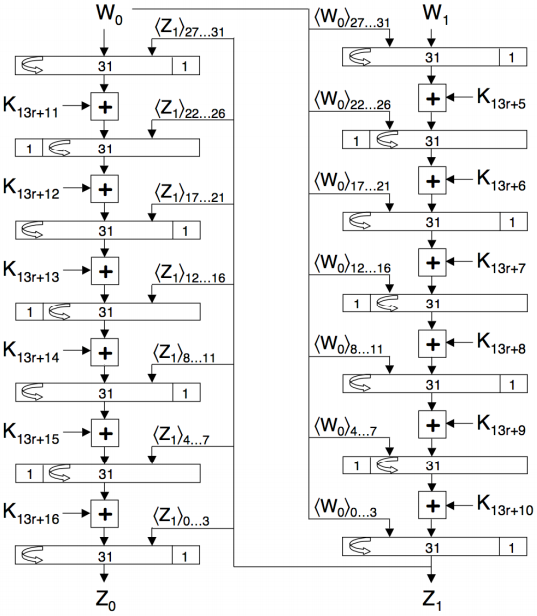
Explain of visual form:


Where:
  • W = X
  • W1 make first
  • Rotate 31 bits, with 1 bit fixed
Taking:

(T0 ,T1), output would AR structure

(T0 ,T1) = AR(B0 ⊕ B2, B1 ⊕ B3), indicating the input values ​​and which has the form AR obtain these.

Later: 

(D0, D1, D2, D3), output would round r.

Then:

(D0, D1, D2, D3) = (B0⊕T1, B1⊕T0, B2⊕T1, B3⊕T0)

One Time to Finished This:

The Block (D0, D1, D2, D3) whold:
  • The entrance of the next round.
  • If the last one, whold the output of all the process.
For the decryption process would use the same process only data that would introduce a little different.


Math Type which is based

As based on IDEA uses XOR (⊕) combined with rotation values, and modular arithmetic.


Example


The following is a problem which show difficulties if used have certain values ​​in this.


-------------------------------------------------------------------------------------------------------------------


Only to start:

  • z is K in the explication.

Given X = (0x53,0x8d,0x86,0x80), Y = (0x74,0x21,0x9c,0xca):

Create an equation, substituting in the values for x and y:


(0x53-z5) ^ 0x86 ^ z7 = (0x74 + z1) ^ 0x9c ^ z3

Starting with the low-order bit (denoted zi[0]), determine which of the following bit combinations solve the above equation:


(z5[i],z1[i],z3[i]^z7[i]) = ((0,0,0),(0,0,1),...,(1,1,0),(1,1,1))

Provided sufficient plaintext-ciphertext pairs, it should theoretically be possible to uniquely determine the values of the unknown subkeys using this technique.

In order to solve for the unknown plaintext, we need to solve the below equation:


We know the entire right-hand side of the equation and z1 on the left-hand side.

Given sufficient redundancy, it is possible to determine the values of x1 and x3. The papers we read did not go into detail about how to perform this recovery.

Determining z1...z8:

Tried multiple approaches that either resulted in hundreds of potential subkey values, or did not find a single subkey value

           Bit-by-bit as described
                           Resulted in hundreds of matches
           Bit-by-bit, taking carry bits into consideration
                           Resulted in zero matches
           Byte-by-byte bruteforce attack
                           Worked if the input size was a single byte, but did not work otherwise

-------------------------------------------------------------------------------------------------------------------

Let

A = (A0, A1, A2, A3), be input to round r
U = (U0, U1, U2, U3), be result of rotation
T = (T0, T1), be output of AR structure
B = (B0, B1, B2, B3), be output of round r

Denote A = (a0 ,a1,…,a127)
  • And similarly for U,T,B
Let l be size of keyed rotation

Then U = (A <<< l) and (B0, B1, B2, B3) = (U0⊕T1, U1⊕T0, U2⊕T1, U3⊕T0)

It follows that B0⊕B2 = U0⊕U2 and B1⊕B3 = U1⊕U3

AR structure has vanished!

The crucial observation for attack

Atacks Y/O Vulnerabilities

Akelarre shows that your design is complicated encryption.

An attack is conceptually simple, but the details are not so simple.

There is an attack in the year 1997, using Ciphertext-only attack.

It therefore proves to be very vulnerable to attacks.

References:


http://www.schneier.com/paper-akelarre.pdf

http://es.wikipedia.org/wiki/Akelarre_(cifrado)
http://www.sacconference.org/proc/SAC_96_002.pdf
http://es.wikipedia.org/wiki/Cifrado_por_bloques
http://en.wikipedia.org/wiki/Akelarre_(cipher)
http://cs.sjsu.edu/~stamp/crypto/PowerPoint_PDF/12_Akelarre.pdf

martes, 9 de octubre de 2012

Entrada 2


Automatización y Control de Sistemas Dinámicos


Diagrama de Bloques

Para esta entrada consiste en mostrar el diagrama de bloques de la función de transferencia de nuestro proyecto.

Antes de hacer esto, completare la función de transferencia que había hecho en el reporte pasado.

Viendo los valores de entrada y salida (http://materiasdepedrito.blogspot.mx/2012/09/reporte-1.html) tenemos que:

El valor de entrada sería seria la Potencia de la corriente eléctrica, la ecuación de esta es:

P = \frac{dq}{dt} I R

P = Potencia de la corriente eléctrica.
I = Intensidad de la corriente.
R = Resistencia del material del que esta hecho la punta del cautín.
dq/dt = Derivada del calor respecto al tiempo.

El valor de salida seria el Calor producido por el cautín, la ecuación de esta seria:


Q = Calor
m = Masa del Cautín
c = Calor especifico del cautín
Delta T = Diferencia de Temperaturas (Entrada y de Salida)

Teniendo esto la función de transferencia seria:


Aplicando la transformada de Laplace a cada una de las funciones:

Función de Entrada
X(s) = L\left\{{\frac{dq}{dt} I R}\right\}
X(s) = sQ(s) I R

Función de Salida
Y(s) = L\left\{{c m \Delta T}\right\}
Y(s) = \frac{c m \Delta T}{s}

Aplicando la estas funciones a la de transferencia tenemos nuestra función de transferencia

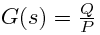
G(s) = \frac{\frac{c m \Delta T}{s}}{sQ(s) I R }
G(s) = \frac{\frac{c m (T_f - T_o)}{s}}{sQ(s) I R }

Ya a continuación muestro el diagrama de bloques:


jueves, 20 de septiembre de 2012

Entrada # 3

Laboratorio de Automatización y Control de Sistemas Dinámicos

Para esta semana, al igual que la anterior, consistió en elegir un problema y resolverlo.

El problema nos dice:


"Considere el que sistema que se muestra a continuación. Calcular la expresión del error en estado estacionario cuando están presentes tanto la señal de entrada de referencia R(s) como la entrada de perturbación D(s)."


Primeramente definir unos conceptos:


Entrada de Referencia.- Impulsos que se le dan al sistema para observar las salidas que tendrían el sistema.


Entrada de Perturbación.- Señales que tienden a afectar al sistema, afectan la salida del sistema; como esta señal es una entrada, por lo tanto esa es externa y se genera fuera del sistema.


Expresión de Error.- Es un valor que nos indica el rango que nos daria el sistema.


De nuestro problema tenemos los siguientes: 


Entrada de Referencia R(s), Entrada de Perturbación D(s) y la Expresión de Error es E(s); C(s) seria la salida que produzca el sistema.

El problema nos pide encontrar la Expresión de Error en estado estacionario (No hay algo externo, aparte de lo mencionado, que pueda afectar la salida) cuando están presentes tanto la señal de entrada de referencia como la entrada de perturbación.


La Expresión de Error se calcula como la suma de salidas (La Esperada + la Producida en estado estacionario), en base a las variables y las definiciones tenemos:


La Esperada seria cuando solamente este presente la variable de referencia en el sistema (para este no incluiremos la de perturbación)


La Producida seria las salidas usando solamente la entrada de perturbación (ya que la referencia se vuelve constante y la de perturbación daría un resultado distinto).


Por lo tanto la ecuación de Error seria:


E(s) = ErrorReferenciaEstacio + ErrorProducidaEstacio


Y ya que como es estacionario tiene que ver con el tiempo nos queda que:


E(s) = E_e_e (t) = E_e_e_R (t) + E_e_e_D (t)


El siguiente paso seria solucionar cada uno de los errores, aquí comenzaremos por el de referencia.


Antes de encontrar cuando el de referencia sea estacionario primero habrá que determinarlo cuando no este así.


Este error se calcula como el valor de la referencia menos la salida producida por el efecto de este:


E_R(s) = R(s) - C_R(s)


Teniendo que la salida de sistema es:


Tenemos que \frac{C_R(s)}{R(s)} = \frac{G_1(s) G_2(s)}{1 + G_1(s) G_2(s)}


Sustituyendo el error de la referencia en la ecuación.


E_R(s) = R(s) - C_R(s) =  R(s)[1 -\frac{C_R(s)}{R(s)}]


E_R(s) =  R(s)[1 - \frac{G_1(s) G_2(s)}{1 + G_1(s) G_2(s)}]
 E_R (s) = {[\frac{1}{1 + G_1(s) G_2(s)}R(s)]}

Ya aplicandolo de forma estacionaria la de referencia


 E_e_e_R (t) = \displaystyle\lim_{t \to\infty}E_R(t) = \displaystyle\lim_{s \to\ 0} s E_R(s)


 E_e_e_R (t) = \displaystyle\lim_{s \to\ 0} {s [\frac{1}{1 + G_1(s) G_2(s)}R(s)]}

Ahora aplicando a las Perturbaciones


 E_D(s) =  0 - C_D(s) = - C_D(s) = - \frac{C_D(s)}{D(s)} D(s)

Teniendo que:\frac{C_D(s)}{D(s)} = \frac{G_2(s)}{1 + G_1(s) G_2(s)}


 E_D(s) = - \frac{G_2(s)}{1 + G_1(s) G_2(s)} D(s)

Sacando la forma estacionaria de las perturbaciones


 E_e_e_D (t) = \displaystyle\lim_{t \to\infty} E_D(t) = \displaystyle\lim_{s \to0} s E_D(s)
 E_e_e_D (t) = \displaystyle\lim_{s \to0} [-\frac{G_2(s)}{1 + G_1(s) G_2(s)} D(s)] s

Sustituyendo las estacionarias:


 E_e_e (t) = E_e_e_R (t) + E_e_e_D (t)
 E_e_e (t) = \displaystyle\lim_{s \to\ 0} {s [\frac{1}{1 + G_1(s) G_2(s)}R(s)]} + \displaystyle\lim_{s \to0} [-\frac{G_2(s)}{1 + G_1(s) G_2(s)} D(s)] s

Referencias

http://www.slideshare.net/ptah_enki/definiciones-de-control-326816
http://isa.uniovi.es/docencia/raeuitig/tema1.pdf

Entrada # 6

Implementing the RSA algorithm in an HTTP (Authenticating Users)

For this week we have to implement the RSA algorithm into a web server.

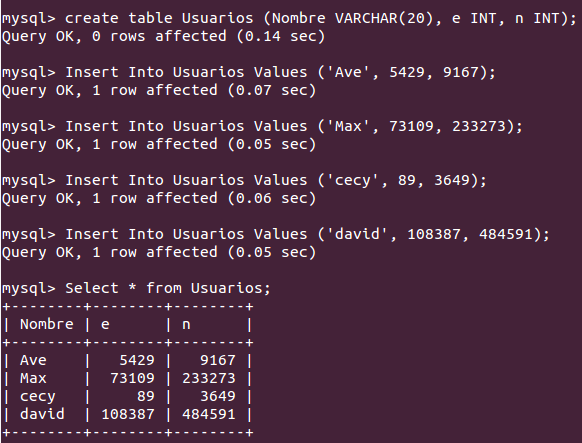
Be has a user to validate your user name, for it makes use of the RSA algorithm, the server and the client need certain values ​​(the server already has the information about your name and values ​​of 'e' and 'n 'while the client would have' d ​​'and' n ').

The process would be the client requests a value of 'x' to the server, this does just that along with the link to download a script to determine the values ​​of 'and' and 'r'.

The client downloads this file and determines the values ​​mentioned above, then the client will provide the server user your name (as must be added, only find the name that is to avoid errors Language Script) together with the value of 'r '.


The server receives this data and using the user name extracts the values ​​of 'e' and 'n' (for storing information this data can use files or databases) and together with the value of 'x' that provides the client.


Obtains two different 'y' (one with a specific function for us - this function is the same as in the script that I download the client - and by the formula r ^ e mod n) and compare these values​​, if these are the same you sends a message to the user indicating that authentication was successful.


Code in PHP 
Script of Python Code of SQL


Vídeo mostrando la ejecución
En Proceso

jueves, 13 de septiembre de 2012

Entrada # 5

Implementación de la Autentificación RSA

En este código se hicieron todos los cálculos para encontrar los valores de n, d y e y los guarda en un archivo junto con los nombres de usuario.

Como logran ver los valores de d y de p y q fueron asignados por mí (Obviamente respetando las reglas).


El orden del texto es: Usuario, valor de e, valor de d y valor de n

Imágenes donde se determino el valor de d:


Después se muestra los códigos donde se hizo uso de los sockets

Cliente

Servidor


Referencias:

http://mundogeek.net/archivos/2008/04/12/sockets-en-python/
http://es.wikipedia.org/wiki/N%C3%BAmero_primo
http://es.wikipedia.org/wiki/N%C3%BAmeros_primos_entre_s%C3%AD
http://www.slideshare.net/jpadillaa/criptografia-asimetrica-rsa